Guide to Celtic Genealogy Research: Fifteen Tools Worth Knowing
I still remember the afternoon I typed my Dad’s name into a search bar on Ancestry.com and watched a thread begin to unspool. One name led to another, hint after hint popped up. I was standing at the edge of something real. That’s the thing about Celtic genealogy research. It doesn’t feel like data entry. It feels like following a trail of breadcrumbs back to a table you somehow always knew existed.
But knowing where to start and where to go next can feel overwhelming when you’re new to it. The internet is full of genealogy sites, and not all of them are created equal, especially when you’re specifically chasing Scottish, Irish, Welsh, Manx, Cornish, or Breton roots. Some tools will take you further than others. Some are free. Some are worth every penny of the subscription.
I’ve gathered the ones I trust, the ones I actually use on my Finding Your Roots in the Celtic Nations resource page. But I wanted to take a little more time here to walk you through each one, the way a friend might over a cup of tea, so you know not just that they exist, but how to actually use them.
Hey, Meanderers. Some links here are affiliate links, meaning I earn a small commission if you use them, at no extra cost to you. I only recommend resources and brands I genuinely trust and would share with a friend. Your support helps keep this journey going—thank you for meandering with me!
The Genealogy Websites
FamilySearch — Start Here, Always
If I could recommend only one resource to a brand-new meanderer, it would be FamilySearch. It is completely free with no subscription, no paywall, and no “try it free for two weeks.” It holds an astonishing number of Celtic records. We’re talking parish registers, census records, emigration lists, probate documents, and more.
FamilySearch is run by the Church of Jesus Christ of Latter-day Saints, which has spent decades digitizing and indexing historical records from around the world specifically to help people trace their families. The Celtic collections are extensive. Start by searching your family surnames, but also take time to browse the historical record collections by country. You’ll often find records there that the general search doesn’t surface.
Pro tip: create a free account. It unlocks the ability to build your tree directly on the platform and see where it connects to trees other researchers have already built. You may find that someone has already done years of work on a branch of your family.
Word of Caution: Please verify, verify, and verify everything before attaching it to your tree. You can’t always know for sure if their work is correct.
Ancestry.com — The Largest Database in the World
When people think of genealogy research, they usually think of Ancestry. And for good reason — it is the largest genealogy database in existence. The UK and Ireland record collections alone are remarkable, and the “hints” feature, which flags potential connections between your tree and records or other people’s trees, can genuinely stop you in your tracks with a discovery you weren’t expecting.
Ancestry does require a subscription for most of its records, and the cost adds up. But if you’re at a stage where you’re actively building and hitting walls, it is almost always worth it. The combination of the record collections, the tree-building tools, and the DNA matching (more on that in a moment) makes it a one-stop shop in a way no other platform quite manages.
My honest advice: start with FamilySearch for free, lay your foundation, and then come to Ancestry when you’re ready to go deeper.
FindMyPast — The British Isles Specialist
Here’s the thing about FindMyPast that a lot of people don’t realize until they’ve been researching a while: it goes deeper into British and Irish records than Ancestry does. The UK and Irish collections here are genuinely exceptional — newspapers, military records, workhouse records, and detailed parish registers that fill in the gaps that feel impossibly stubborn everywhere else.
If you’re specifically tracing English, Scottish, Welsh, or Irish roots and you’ve hit a wall on Ancestry, FindMyPast is often where the wall finally comes down. It’s not a replacement for Ancestry — it’s a companion. Think of them as two different archives in the same city. Each one holds things the other doesn’t.
ScotlandsPeople — Non-Negotiable for Scottish Research
If you have Scottish ancestry, ScotlandsPeople is not optional. It is the official Scottish government genealogy site, which means it holds the most comprehensive collection of Scottish records available anywhere in the world. Birth, marriage, and death records. Census records. Old Parish Registers that date back to the 1500s in some cases. Church records. Wills and testaments.
It works on a pay-per-view credit system rather than a subscription, which I actually appreciate — you pay for what you access rather than a blanket monthly fee. The records are authoritative, and the level of detail is extraordinary. I have found information on ScotlandsPeople that simply does not exist anywhere else.
When I was tracing the Lundy line back to Fife, ScotlandsPeople was where the breadcrumbs led. It’s where they usually lead, for Scottish research.
IrishGenealogy.ie — Free Irish Records Straight from the Source
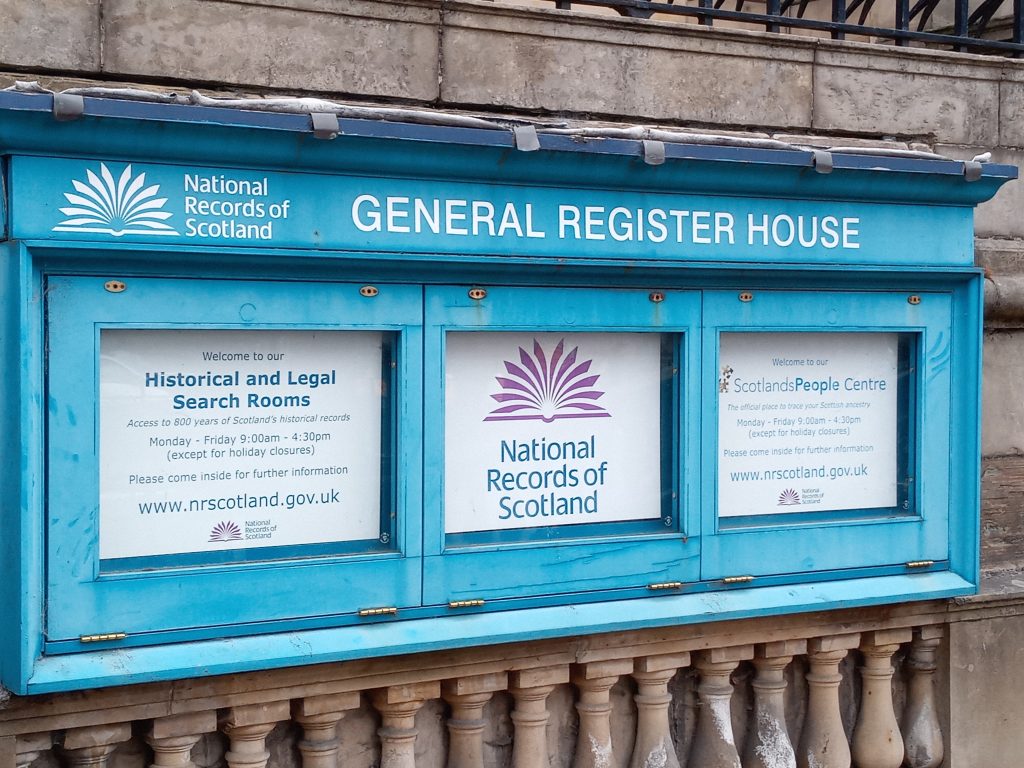
Irish genealogy research has some unique challenges. There is the 1922 destruction of the Public Record Office in Dublin, which wiped out an enormous amount of historical documentation, leaving gaps that can feel heartbreaking when you’re trying to trace a family. But IrishGenealogy.ie is a free government resource that offers access to civil registration records (births, marriages, deaths from the mid-1800s onward) as well as a growing collection of church registers.
Start here before you pay for anything Irish-related. The site is simple and the records are genuinely useful, especially for anyone with 19th or early 20th century Irish ancestry. It’s not comprehensive, but it is free, and it is official.
Before We Talk DNA: Free UK and Irish Resources Worth Bookmarking
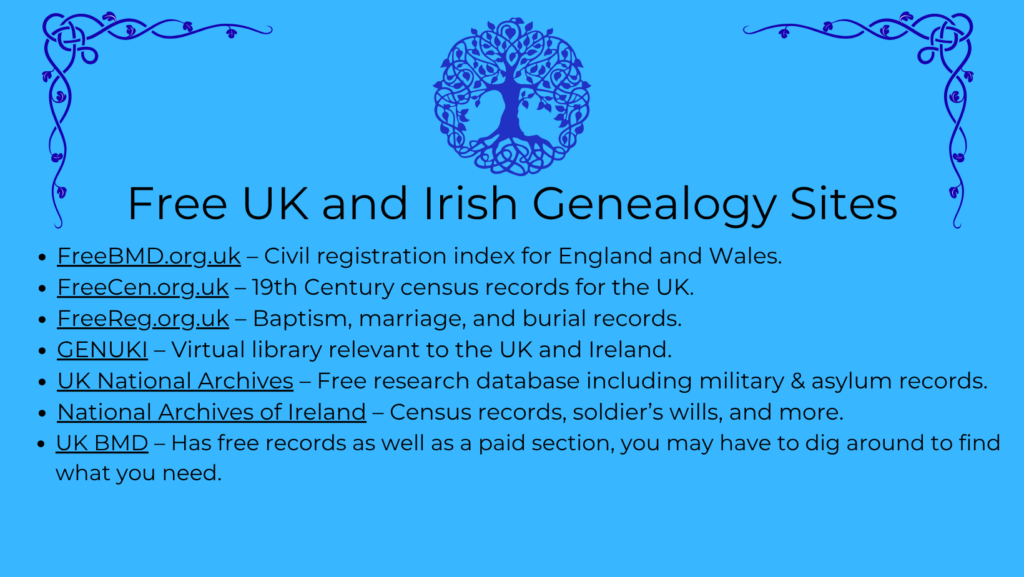
Before we get into DNA testing, I want to make sure you know about a handful of free UK and Irish genealogy sites that don’t always get the attention they deserve. These are quiet workhorses that are not as well-known as the big platforms, but genuinely useful, and they won’t cost you a thing.
Bookmark this section. These sites have filled in gaps for countless researchers — sometimes surfacing the exact record that every paid platform had missed.
FreeBMD.org.uk — A civil registration index for England and Wales covering births, marriages, and deaths from 1837 onward. Completely free and searchable online. If your Welsh or English ancestors appear in Victorian records, this is a strong first stop.
FreeCen.org.uk — Volunteer-transcribed 19th-century census records for the UK. A wonderful complement to the paid census collections on Ancestry or FindMyPast, and entirely free.
FreeReg.org.uk — Baptism, marriage, and burial records transcribed by volunteers. Particularly useful for pre-civil registration research when parish records are your only option.
GENUKI — Think of this as a virtual library for UK and Irish genealogy. It doesn’t hold records itself, but it is an extraordinary directory of resources organized by country, county, and parish. If you’re not sure what records exist for a specific place, GENUKI will tell you.
UK National Archives — A free research database that includes military records, asylum records, and much more. The depth here can surprise you — well worth exploring if your ancestors had any military connection or brushed up against official records.
National Archives of Ireland — Census records, soldiers’ wills, and more, all freely accessible. An essential companion to IrishGenealogy, i.e, for anyone tracing Irish roots.
The DNA Testing Services
I want to say something important before we get into the specific services: DNA testing is a companion to genealogy research, not a replacement for it. Your results will not hand you a family tree. What they will do is confirm the research you’ve already done, open new doors you didn’t know existed, and occasionally, completely upend something you thought you knew.
I didn’t test my own DNA until several months into my research. By then, I had a foundation to make sense of the results. That order — research first, DNA second — is the approach I always recommend.
AncestryDNA — The Biggest Matching Pool
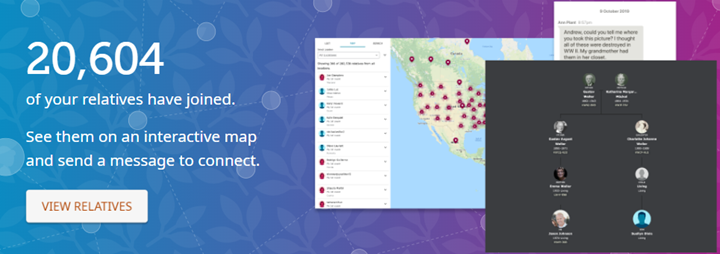
In DNA testing, database size matters more than almost anything else, because matches come from people who have also tested. The bigger the database, the more potential matches. And AncestryDNA has the largest DNA database available, by a significant margin.
If you already have an Ancestry subscription, adding DNA testing is a natural move — your results live alongside your family tree, and Ancestry’s “ThruLines” feature uses both your tree and your matches’ trees to suggest how you might be connected to DNA matches. It’s not always accurate, but when it works, it can be genuinely revelatory.
MyHeritage DNA — The International Connector
The Celtic diaspora is one of the most widespread in the world. Scottish, Irish, and Welsh descendants ended up in Australia, New Zealand, Canada, South Africa, Argentina, and across the United States — and many of their descendants are researching their roots today. MyHeritage DNA has a particularly strong international database, which makes it especially valuable for this kind of diaspora research.
If your goal is to find cousins, you didn’t know existed — people scattered across the world who share your Celtic roots — MyHeritage is often where those connections surface. It’s a different pool than Ancestry, which means different matches. Many serious researchers test both.
LivingDNA — The Regional Breakdown Specialist
LivingDNA is smaller than AncestryDNA or MyHeritage, and its matching pool reflects that. But it does something no other testing service does as well: regional specificity within the British Isles. Their ethnicity breakdowns can place your ancestry within specific regions of Scotland, Ireland, and Wales — not just “Scottish” but Highland, Lowland, Orkney. Not just “Irish” but Munster, Ulster, Connacht.
For meanderers who want to understand not just that they have Celtic roots but where in the Celtic nations those roots are concentrated, LivingDNA is worth the test. The database size is a limitation for matching purposes, but for understanding the regional story of your ancestry, it is unmatched.
Final Thoughts
Every name you find is a door opening. That’s something I genuinely believe. The records exist. The DNA matches are out there. The tools above are how you find them.
If you’re not sure where to start, start with FamilySearch — free, comprehensive, and genuinely powerful. Build your foundation. Then follow where the research leads you.
I’ve gathered all of these resources — with direct links — on my Finding Your Roots in the Celtic Nations resource page. Bookmark it, come back to it, and use it whenever you’re ready to take the next step on your ancestral journey. You can find it here: Finding Your Roots in the Celtic Nations
Happy meanderings. Slànte Mhath!