
Mastering Wildcard Searching For Genealogy
Have you ever been certain an ancestor’s record exists, only to get zero results? Before you give up on the brick wall, check the spelling. The culprit is often a transcription error, a clerk who wrote down what he heard, or a surname that wandered through three spellings in one family. A wildcard search can fix that.
What is a wildcard search?
A wildcard is a placeholder you type in place of a letter you’re unsure about. Instead of making the database match one exact spelling, you ask it to look for several at once. Two symbols do nearly all the work:
- The question mark (?) stands in for exactly one letter.
- The asterisk (*) stands in for a run of letters, including none at all.
Putting it to work with Lundy
My maiden name is Lundy, and it shows how even a short, simple surname can hide in an index.
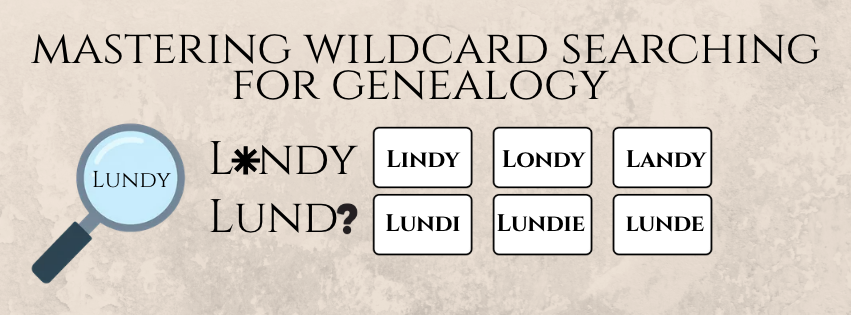
When one letter is the question: L?ndy. A faded u can easily be read as an a or an o. This search brings up Lundy, Landy, Lindy, and Londy in one go.
When the ending wanders: Lund*. Surnames were shortened, lengthened, and re-spelled as families moved. This catches Lund, Lundy, Lundie, and Lundin. Lundie and Lundin are well worth checking if your roots are Scottish. Expect some noise too, because names like Lundquist will show up. They’re different families, so skip past them.
When the middle letters are a smudge: L??dy. Census handwriting often runs letters together. This finds Lundy, Landy, and misreadings like Lumdy.
Try it with a Celtic surname: M*donald gathers McDonald, MacDonald, and Mcdonald, which is handy for any Mac/Mc name.
A few rules of the road

- Every site plays by its own rules. On Ancestry, you need at least three non-wildcard letters, so Lu* is too short, but Lun* works. The asterisk also covers a limited number of letters. Check the search tips page on each site before you start.
- Start small. Use one wildcard per name field so your results stay manageable. If you get a flood, add a place or a birth year.
- Don’t limit it to surnames. Given names have as many spelling variations as surnames. ?atherine finds both Catherine and Katherine.
- Keep a log. Note which wildcard search you’ve run, so you don’t repeat them on your next research day.
Wildcards won’t break down every wall, but they clear away the ones built from spelling alone.
In search of old footprints, Sláinte!
If you enjoyed today’s journey, you can buy me a cuppa to support future pieces. Tapadh leibh.